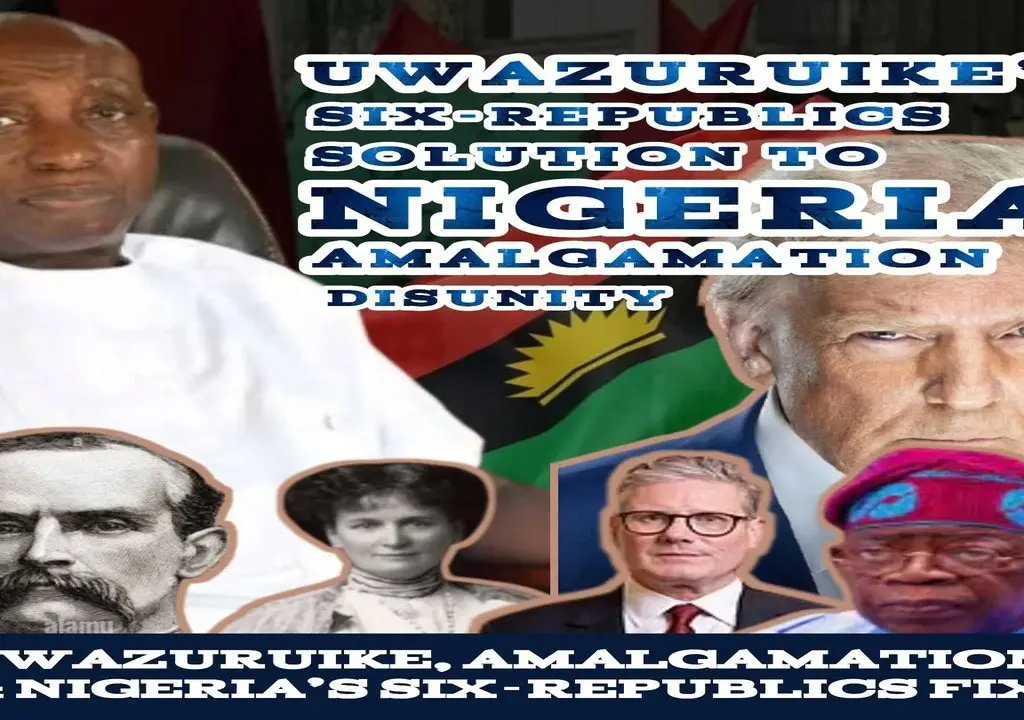
Ralph Uwazuruike advocates peaceful restructuring of Nigeria
Ralph Uwazuruike has renewed his call for the peaceful restructuring of Nigeria into six independent republics, describing the proposal as a long-term response to the political, ethnic, and security challenges that have continued to affect the country since the 1914 British amalgamation.
The position was contained in a statement published on May 2, 2026, through the official Facebook handle of Comrade Ijeomah Anthony, Minister of Information of the Biafra Internal Government. The statement outlined Ralph Uwazuruike’s long-standing argument that the current Nigerian structure remains under pressure because it was formed without the consent of the various ethnic nationalities brought together during colonial rule.
According to the report, Ralph Uwazuruike believes many of the tensions confronting Nigeria today can be traced to the 1914 decision by the British colonial administration to merge the Northern and Southern Protectorates into one political entity known as Nigeria.
The amalgamation, historians have noted, was primarily designed for administrative and economic convenience during British colonial rule. However, critics of the arrangement have argued that the union failed to consider the deep cultural, political, religious, and social differences among the various peoples living within the territory.
The statement explained that the Northern region largely operated through emirate systems and Islamic institutions, while the Southern region consisted of multiple traditional structures, growing commercial networks, and increasing exposure to Western education at the time.
Despite these differences, the regions were merged into a single country under colonial administration without public consultation or referendum. Supporters of restructuring have often pointed to this process as the beginning of many of Nigeria’s modern political disagreements.
According to the publication, Ralph Uwazuruike believes the effects of the amalgamation remain visible in the form of insecurity, ethnic distrust, uneven development, regional tensions, and struggles over resource control.
The statement also linked the country’s historical divisions to later political crises, including the Nigerian Civil War. On May 30, 1967, the Republic of Biafra was declared following rising tensions, violence, and loss of confidence in the Nigerian federation.
The war that followed resulted in widespread casualties, displacement, and humanitarian suffering. Although the conflict officially ended in 1970 under the “No Victor, No Vanquished” policy, debates about national unity, restructuring, and coexistence have continued over the decades.
Years later, on May 22, 2000, Ralph Uwazuruike reintroduced the Biafra struggle through the Movement for the Actualization of the Sovereign State of Biafra, popularly known as MASSOB. Unlike the armed conflict of the late 1960s, the movement adopted a non-violent approach centered on civil resistance and advocacy.
The statement emphasized that Uwazuruike’s position extends beyond the Biafra question alone. According to the publication, he believes the larger issue lies in the structure of Nigeria itself rather than in one specific region.
It stated that many communities across the country, including those in the South East, South South, South West, North Central, North East, and North West, have at different times expressed concerns about insecurity, political representation, economic hardship, and local control over resources.
As part of his proposed solution, Ralph Uwazuruike advocates dividing Nigeria into six republics based on the existing geopolitical zones.
The proposed republics include:
- South East
- South South
- South West
- North Central
- North West
- North East
According to the statement, each republic would be responsible for managing its own security, economy, natural resources, and internal development while maintaining peaceful relations with neighboring regions.
Supporters of the proposal argue that such an arrangement could reduce political tensions and allow each region to develop according to its priorities and cultural identity. They also believe decentralization may encourage accountability and improve governance at regional levels.
However, critics of restructuring and separatist proposals maintain that Nigeria’s unity remains important for economic strength, political stability, and international influence. Some analysts have warned that dividing the country could create additional political and economic uncertainties if not carefully managed.
The statement noted that Ralph Uwazuruike continues to insist on dialogue rather than violence. According to the report, he believes all ethnic nationalities should be invited to a roundtable discussion to openly debate Nigeria’s future and determine the most workable arrangement peacefully.
The publication stressed that the proposal is not presented as a call for conflict or instability but as an appeal for negotiation and mutual understanding among the country’s diverse groups.
Supporters of restructuring have argued that more than 100 years after amalgamation, many Nigerians continue to identify more strongly with ethnic and regional identities than with a unified national identity. They point to recurring political disagreements, regional agitation, and security concerns as evidence that the present system requires serious review.
The statement also highlighted rising insecurity and economic hardship as factors increasing public discussions about restructuring. Across different regions of the country, citizens have raised concerns about unemployment, inflation, safety, and access to opportunities.
For many observers, the restructuring debate is no longer limited to political elites or activist groups. It has increasingly become part of broader conversations about governance, national development, and social stability.
According to the statement, Ralph Uwazuruike believes peaceful dialogue remains the only sustainable path forward. He argues that any future political arrangement should emerge through consultation, negotiation, and collective agreement rather than violence or coercion.
Political analysts note that debates about restructuring are not new in Nigeria. Over the years, different groups and stakeholders have proposed constitutional reforms, fiscal federalism, regional autonomy, and devolution of powers as ways of addressing the country’s challenges.
Some advocates support stronger federalism within one united Nigeria, while others favor confederation or complete regional independence. Uwazuruike’s six-republic proposal represents one of the most far-reaching positions within that broader national discussion.
Observers say the conversation surrounding Nigeria’s future structure is likely to continue as economic and security challenges persist. Questions about resource control, representation, governance, and regional autonomy remain central to political debates in several parts of the country.
The publication concluded that Ralph Uwazuruike sees peaceful negotiation as essential to preventing deeper divisions in the future. According to the statement, he believes every region should be allowed to determine its direction through open discussion and mutual respect.
For supporters of the proposal, the focus remains on creating what they describe as a more balanced and peaceful system of coexistence. For critics, however, maintaining national unity while addressing structural concerns remains the preferred path.
As discussions continue, the debate over restructuring, federalism, and national identity is expected to remain a significant part of Nigeria’s political landscape in the years ahead.
The statement was signed by Comrade Ijeomah Anthony, Minister of Information, Biafra Internal Government, and published through his official Facebook platform on May 2, 2026.
Additional Information
Readers seeking more background on Ralph Uwazuruike, his six-republics proposal, and past statements on restructuring Nigeria can visit the external sources below for additional reports, historical context, and related developments.
External Links
- The Nation Nigeria – Uwazuruike says Nigeria should split into six regions
- The Sun Nigeria – Nigeria’ll soon split into six nations, says Uwazuruike
- Vanguard Nigeria – Nigeria’ll break into six republics before 2023, Uwazuruike says
- Daily Post Nigeria – Nigeria will break into six republics before 2023, Uwazuruike says
- Daily Times Nigeria – Nigeria set to break into six republics before 2023,Uwazuruike
These reports provide additional insight into Ralph Uwazuruike’s long-standing views on restructuring, regional autonomy, and the debate surrounding Nigeria’s political future.